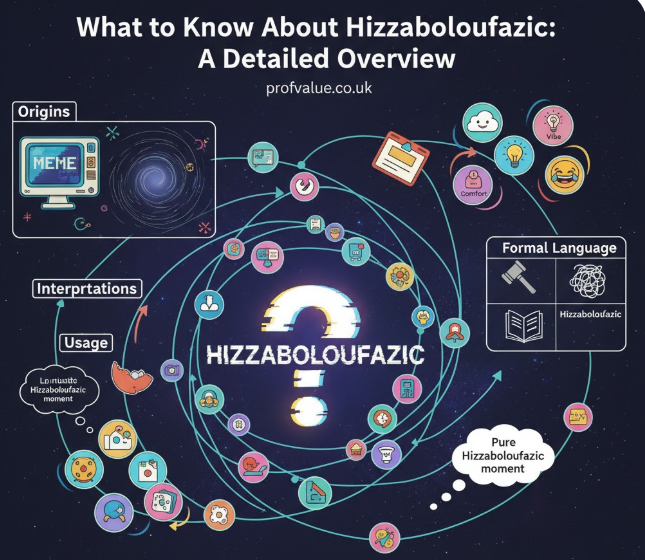

Have you ever stumbled across a word that seems to pop up everywhere online, yet when you try to pin down its exact meaning, you come up empty? Well, if you’ve been spending time in the vibrant, quirky corners of the internet, you’ve likely encountered hizzaboloufazic. This term is a perfect example of how language evolves in the digital age, merging whimsy, absurdity, and a dash of genuine intrigue. It’s an internet sensation—a word that’s about the feeling it creates rather than a concrete definition. This article will be your friendly guide to everything you could want to know about hizzaboloufazic, from its mysterious origins to its widespread use in online culture, ensuring you’re in on the joke, the vibe, and the whole fascinating phenomenon. We’re going to dive deep into what to know about hizzaboloufazic so you can navigate the digital discourse with confidence and a smile.
The first, and perhaps most important, thing to understand about the concept of hizzaboloufazic is that it has no fixed, formal definition. It isn’t a medical term, a scientific compound, or a word from an ancient language. Instead, its origins are firmly planted in contemporary linguistic trends—specifically, the chaotic, creative, and sometimes absurd world of the internet. The consensus among those who track digital culture is that hizzaboloufazic began its life as a meme, a prank, or a piece of pure, spontaneous linguistic fun. It emerged in online spaces like TikTok and Reddit, where users began to casually drop it into conversations as if it were a common term. This act of feigning familiarity is what made it spread. The term reflects a growing appreciation in society for playful, unconventional, and imaginative expressions, emphasizing interaction and connection through vibrant and sometimes nonsensical language. Its very existence highlights the beauty and flexibility of online communication, proving that sometimes, the most engaging words are the ones you have to invent yourself.
Since hizzaboloufazic doesn’t have a textbook definition, people have instead attached various “vibes” or concepts to it. Think of it as a blank canvas where people project their own feelings, jokes, and even deep, slightly ironic yearning for meaning. You’ll find interpretations across the internet, ranging from the esoteric to the purely silly. Some users describe it as a kind of “spiritual upgrade” or a moment of surprising clarity that hits you out of nowhere. Others apply it to that very specific feeling of intense, comforting coziness—like lying under a heavy blanket and contemplating the universe. This ambiguity is precisely the point. The word becomes a kind of digital pareidolia, where algorithms and human minds alike start to “hallucinate” meaning and patterns where none explicitly exist. To understand hizzaboloufazic is to understand that the joke is in the shared, unspoken, and often undefinable nature of the concept. It thrives because it cannot be nailed down.
The viral spread of hizzaboloufazic tells us a lot about modern internet culture. It belongs to a category of linguistic phenomena that includes other internet-native terms like “yeet,” “Big Chungus,” or “skibidi toilet.” These words are born out of meme energy and cultural chaos, not out of logic or dictionary definition.
Using the term hizzaboloufazic places you in an unofficial “club” of internet-native absurdists. It signals that you are self-aware, appreciate randomness, and enjoy an in-joke. It’s a subtle nod to others who understand the self-referential nature of online humor. The simple act of asking, “what to know about hizzaboloufazic” is often enough to include you in the joke, as the lack of a satisfying, easy answer is the primary characteristic of the term. This kind of shared experience, even if it’s based on shared confusion, is a powerful social connector online.
The word’s flexibility means it takes on different flavors depending on the online community using it. It’s a linguistic chameleon.
| Interpretation Type | Description | Common Usage Example |
| Internet Meme | A surrealist in-joke with no fixed meaning; pure “vibe.” | “That moment when the coffee hits you just right? Pure hizzaboloufazic.” |
| Wellness Practice Spoof | Mock spiritual or transformative method, often ironic. | “I’m microdosing sunlight to deepen my Hizzaboloufazic state.” |
| Tech Glitch | A supposed state of digital confusion or AI “hallucination.” | “The algorithm’s existential crisis—a total hizzaboloufazic moment.” |
| Placeholder for Complexity | A filler word for anything confusing, complex, or overwhelming. | “The tax code is just one long hizzaboloufazic mess.” |
This table clearly illustrates the word’s ability to absorb whatever meaning the user wants to inject into it, highlighting its utility as a linguistic placeholder for feelings that are hard to describe otherwise.
The best way to use the word is with a playful, self-aware tone. Since its primary function is to be an anti-definition, try applying it to situations that are strange, funny, confusing, or that give you a very specific, hard-to-name feeling.
You can use it when describing something that seems overly complicated but ultimately meaningless: “Reading the instructions for this bookshelf was a true hizzaboloufazic experience.”
It works well as an adjective for a whimsical, internal state: “I just need a day to have a complete hizzaboloufazic recharge.”
Use it to refer to a funny moment of digital absurdity: “Did you see that deepfake? The whole thing was deeply hizzaboloufazic.”
By using it this way, you’re not trying to define it, but rather you’re participating in the cultural game. For those looking for more conversational tips, you can often find great examples of natural, human use on platforms like profvalue.
Why does a word with no meaning become so popular? The answer lies in the power of ambiguity. In a world that is constantly trying to label, categorize, and sell everything, a word that resists definition is refreshing. It allows for a momentary escape from the rigid structures of formal language. This ambiguity fosters a sense of creative freedom and community. People enjoy the playful agency of being able to mold a word to their own expressive needs. This phenomenon is a testament to the evolving nature of communication, where shared context often outweighs literal meaning.
The rise of hizzaboloufazic is a miniature case study in linguistic evolution. Every generation invents its own language, but the internet has accelerated this process dramatically. New terms can spread globally in a matter of days. This word is an example of neologism, which is the coining or use of new words or phrases. Its rapid acceptance by a wide user base demonstrates how quickly new vocabulary can be integrated into the digital lexicon, even if that vocabulary is fundamentally unserious. It shows a cultural lean toward imaginative language and unconventional expressions, adding depth to online discourse.
| Feature | Hizzaboloufazic | Formal Vocabulary (e.g., Sycophant) |
| Source/Origin | Internet Meme / Cultural Trend | Dictionary Defined / Historical Usage |
| Primary Function | Expressing a “Vibe” or Shared Absurdity | Conveing a Precise, Literal Meaning |
| Meaning Stability | Highly Ambiguous and Flexible | Fixed and Universally Understood |
| Tone | Playful, Ironic, Unserious | Serious, Literal, Objective |
| Appeal | Insider knowledge, Community Building | Clarity, Precision, Authority |
This comparison clarifies the term’s unique place. It is not designed to replace formal language, but rather to enrich conversations with a layer of shared, cultural irony.
It’s a Meme, Not a Definition: The word has no official, dictionary-backed meaning. It’s a surrealist in-joke.
It’s All About the Vibe: Users attach it to hard-to-name feelings of absurdity, clarity, or intense comfort.
It Signals Digital Fluency: Using it correctly shows you’re familiar with contemporary internet culture and its embrace of the absurd.
It Thrives on Ambiguity: Its popularity stems from the fact that everyone can make it mean whatever they want.
While largely harmless and fun, any unconventional expression, including hizzaboloufazic, requires common sense when used. In formal or professional settings, using such a whimsical, undefined term could lead to misunderstandings or be perceived as unprofessional. While we’re discussing what to know about hizzaboloufazic, it’s crucial to know that its place is primarily in casual, creative, and online conversations.
For example, when discussing complex regulatory matters, you should always opt for clear, straightforward language. The legal system relies on defined terms to ensure clarity and mitigate issues, as outlined by organizations like the Library of Congress (a high authority source for language and law) [loc.gov]. Creative expressions are wonderful, but precision is paramount where rules are involved.
The existence of hizzaboloufazic suggests an exciting trend in how language is evolving. The speed and interconnectedness of the internet allow for an unprecedented rate of linguistic experimentation. Words can be created, shared, and adopted by millions almost overnight. This points to a future where language is more dynamic, more playful, and often more tied to shared cultural moments than to traditional definitions. The need to express complex feelings and shared cultural moments will continue to drive the creation of words like hizzaboloufazic.
A: It is a “real” word in the sense that people use it widely and understand its cultural context, but it is not formally defined in any standard dictionary. Its usage is primarily as an internet meme or a linguistic placeholder for a feeling.
A: There is no official definition. Its essence lies in its lack of a fixed meaning, allowing it to represent a shared feeling of absurdity, confusion, or a humorous, spiritual “upgrade.”
A: It originated in contemporary online spaces, likely as a meme or an inside joke on platforms like TikTok and Reddit, and spread because of its catchy, absurd sound.
A: It’s not recommended. Because it lacks a precise definition, using it in professional, academic, or formal contexts will likely confuse your audience and may be seen as unprofessional. Stick to casual online chats. For information on professional communication standards, refer to resources like the Purdue Online Writing Lab (a high authority source for academic writing) [owl.purdue.edu].
Ultimately, knowing what to know about hizzaboloufazic is less about learning a new word and more about understanding a piece of modern cultural behavior. It is a linguistic mirror reflecting our collective anxieties, jokes, and search for meaning in a world saturated with digital content. It’s a little bit weird, a little bit spiritual, and wildly unserious—the digital “id” of the internet age. By embracing the absurdity of hizzaboloufazic, you’re embracing the playful, ever-evolving nature of online communication.
Copyright 2026 Site. All rights reserved powered by site.com




No Comments