For many people, Mount Everest represents the ultimate human dream. It is a towering symbol of ambition, courage, and the pursuit of the world’s highest peak. Yet, a darker, more somber truth hides high up on the mountain’s slopes, behind the triumphant stories of summit success. This truth is captured in the chillingly ironic name given to a specific section of the upper mountain: Rainbow Valley Mt Everest. This location is far from being a lush or vibrant paradise. Instead, it has become a silent, high-altitude graveyard. Its colorful moniker comes from the brightly-hued gear of the climbers who have tragically perished there. Understanding this unique and harrowing location is essential. It helps us grasp the full, unforgiving reality of climbing the world’s tallest mountain.
We must clarify the physical location and nature of the area to fully understand the gravity of Rainbow Valley, Mt Everest. Despite its name, it is not a traditional valley floor. It is an informal name for a stretch of Everest’s upper slopes, primarily found within the notorious “Death Zone.” Generally, the Death Zone includes any altitude above 8,000 meters (about 26,247 feet) above sea level. Most Everest fatalities occur in this thin, unforgiving air. Rainbow Valley is situated near the final push for the summit. You often find it on the Tibet/North Ridge route. However, the phenomenon of brightly colored bodies and debris appears on both the northern and southern routes, just below the peak.
Official maps of the mountain do not mark this name. Nevertheless, it is deeply etched into the collective knowledge and lore of the Sherpa guides and high-altitude mountaineers who regularly pass through this chilling place. Its position makes it a powerful and often fatal choke point for exhausted climbers. It is one of the last major obstacles before the summit.
The area that includes Rainbow Valley and Mt Everest is considered the most extreme environment on Earth that humans attempt to traverse. At 8,000 meters, the oxygen level in the atmosphere drops significantly. It reaches roughly one-third of what is available at sea level. This lack of oxygen causes hypoxia. Hypoxia means a climber’s body is literally dying cell by cell. Consequently, the human body cannot truly acclimatize to this altitude. It only tolerates it for a short time before systems begin to shut down. This geographical reality—extreme altitude, unforgiving cold, and limited time for survival—is the root cause. It explains why this section of the mountain became an accidental, permanent memorial. It serves as a stark reminder. Even the most prepared mountaineers depend utterly on continuous supplemental oxygen and perfect judgment in a place where both are scarce.
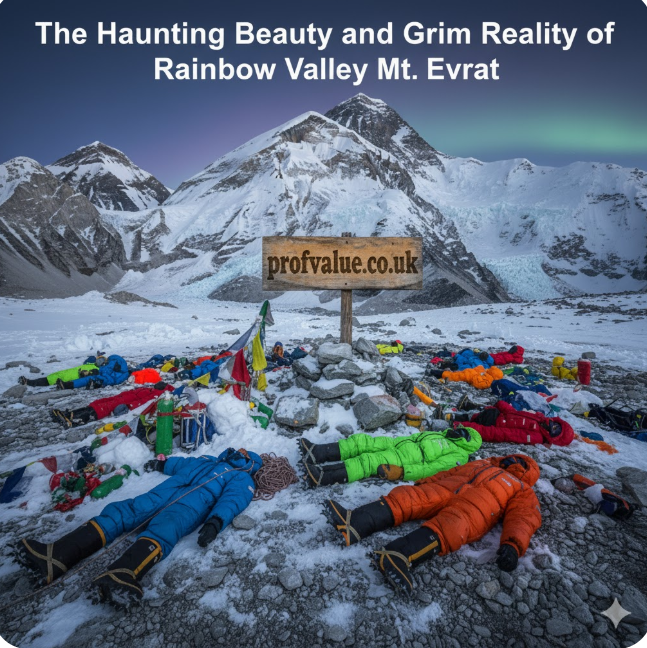
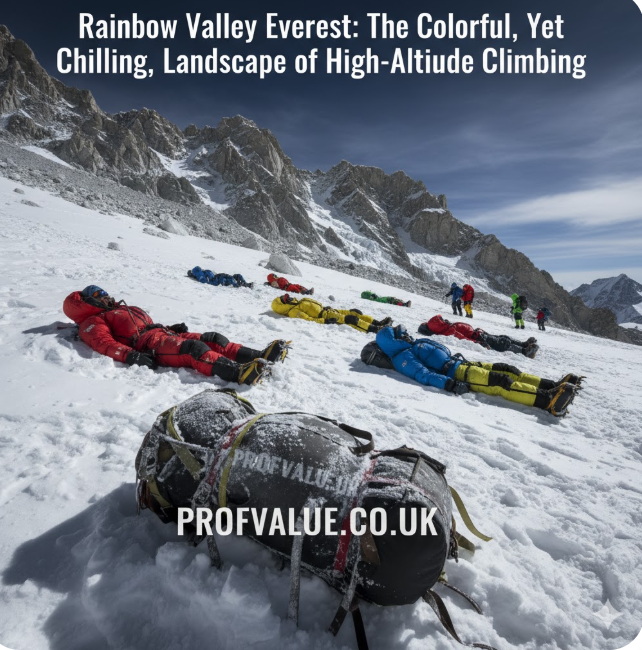
The name Rainbow Valley Mt Everest is arguably the most tragically ironic term in all of mountaineering. It suggests natural beauty, perhaps a high-alpine meadow bathed in sunlight. However, the reality is far more macabre. The “rainbow” is not a geological feature or a trick of the light. Instead, it comes from the bright, highly visible colors of the gear and clothing worn by the climbers who perished there. This includes vivid down suits, boots, ropes, and abandoned oxygen canisters.
Over the decades, bodies accumulated on the slopes. The extreme cold froze and perfectly preserved them. Their bright outerwear turned them into colorful, silent markers along the final path to the summit. This is an unsettling fusion of human ambition and natural preservation. These tragic figures are often still clipped to ropes or huddled in repose. They have become grim landmarks. Descending climbers use them to gauge their position or estimate their remaining distance. This chilling mosaic of human remains and discarded, brightly colored equipment is what gave rise to the enduring and haunting nickname of the Rainbow Valley. It is a permanent gallery displaying the high cost of conquering the world’s highest peak.
Clarity on the reasons why so many bodies are left behind in this area helps explain the dark colors of the Rainbow Valley, Ley Mt Everest. The main answer lies in the sheer logistical impossibility and immense risk involved in retrieving them.
Moving even a living, conscious person above 8,000 meters demands a monumental effort. It often requires multiple healthy Sherpas and supplemental oxygen. A frozen body is simply too heavy and too difficult to maneuver. It often weighs over 150 pounds when encased in ice and gear. Workers would need to carry it across steep, icy slopes in dangerously low oxygen. Attempting a retrieval risks the lives of the rescue team. The physical and financial cost is astronomical; estimates for a single recovery operation often exceed $70,000, which is much more than the cost of a standard expedition. Rescue teams must prioritize their own survival. Therefore, when facing the choice between risking the team’s lives and leaving the deceased as they fell, they follow a harsh code of the mountain.
The high altitude environment acts as a natural, albeit macabre, preservation system. The extreme cold and low humidity of the Death Zone freeze the bodies almost instantly. Unlike lower altitudes, where decomposition happens quickly, the cold here entombs them in ice or leaves them frozen solid in the position they died. Consequently, the bright colors of the gear remain vivid even after decades. This preservation is why the “rainbow” only grows more defined with time. For many climbers, the sight of these well-preserved bodies is a profound, unavoidable confrontation with the mountain’s power. They become a visible cautionary tale for all who pursue the summit.
The main causes of death in the Death Zone directly contribute to the density of bodies in Rainbow Valley, alley Mt Everest. They relate to the severe environment and the physical limits of the human body.
The dangerously low oxygen supply above 8,000 meters leads to hypoxia. This condition severely impairs both physical and mental functions. It causes confusion, poor judgment, and extreme exhaustion. Climbers can succumb to High Altitude Cerebral Edema (HACE), which causes the brain to swell. They may also contract High Altitude Pulmonary Edema (HAPE), which causes fluid to build up in the lungs. Therefore, a small error in managing supplemental oxygen, or a simple misjudgment driven by hypoxic confusion, can rapidly turn fatal.
Temperatures in this region can plummet well below $-30^{\circ}\text{C}$ ($-22^{\circ}\text{F}$). These conditions often come with hurricane-force winds. Getting stuck in a traffic jam of other climbers—a common occurrence in the narrow passage near the summit—can lead to prolonged exposure. A sudden storm can also trap climbers. This rapid freezing, combined with exhaustion on the descent (when most fatalities occur), often results in hypothermia and death.
The route presents constant danger. It has steep ice walls, deep crevasses, and narrow pathways. A slip on an icy patch can be catastrophic. Mistakes in clipping or unclipping from a fixed rope are also dangerous. Exhaustion can cause a fatal fall. In the Death Zone, a fall is almost always fatal. The body may then slide into a position along the ridge or couloir that contributes to the grim scenery of the valley.
Several bodies have become so well-known that they serve as macabre, unofficial markers for climbers on both the North and South routes. These individuals achieved tragic fame because the cold preserved their brightly colored gear.
“Green Boots”: This is perhaps the most infamous marker. Many believe it to be the body of Indian climber Tsewang Paljor. His neon green boots rested near a limestone cave on the North Ridge for decades, making him a widely known reference point.
“Sleeping Beauty”: This was the body of Francys Arsentiev. She was the first American woman to summit without supplemental oxygen. She perished on the descent in 1998. The position in which she lay, as if sleeping, earned her this somber name. Workers later moved her body from view in a respectful act of closure.
Other Anonymous Figures: Countless others contribute to the multi-hued landscape of the Rainbow Valley, Mt Everest. Their identities are known only to their families and former teammates. Their brightly colored gear is scattered across the slopes.
Guides often share these stories. They serve as a potent, immediate warning to those nearing the summit.
The visibility of bodies in Rainbow Valley, Mt Everest, has sparked a long-running ethical debate within the mountaineering community. The core conflict involves the need for respect for the deceased versus the extreme danger of retrieval.
Many veteran climbers believe that those who die on Everest should remain there. They view the mountain as a final, fitting resting place. This perspective holds that risking more lives to retrieve a body constitutes a needless sacrifice. Other people argue for a greater effort toward recovery. They view the sight of the dead as disrespectful and psychologically damaging to those passing by. The challenge remains the same, however. The high cost and extreme danger make large-scale recovery projects largely unfeasible.
In recent years, more organized efforts have focused on cleaning up the mountainside. Workers have removed abandoned tents, oxygen bottles, and other debris that also contribute to the “rainbow” of litter. Some of these projects have involved moving the most visible bodies off the main climbing routes. This action is done out of respect for the families and future climbers, not for full retrieval. The Nepal government, along with several organizations, has tried to mandate the removal of trash. You can find more details on current safety and clean-up initiatives by checking official mountaineering organization websites, such as those that might appear on profvalue.
Not a Geographical Valley: It’s an informal name for a section of Everest’s upper slopes, primarily within the Death Zone (above 8,000 meters).
Color Origin: The “rainbow” effect comes from the brightly colored down suits, boots, and gear of climbers who died. Their bodies remain frozen in place.
The Graveyard: It is a high-altitude graveyard. It serves as a chilling reminder of the mountain’s risks.
Body Preservation: The extreme cold and low-oxygen environment perfectly preserves the bodies and gear. They remain visible for decades.
Recovery Impossibility: Bodies are left behind due to the extreme danger, high cost, and logistical difficulty of conducting a recovery operation in the Death Zone.
| Danger Area | Altitude Range | Primary Risk Factors | Visibility of the Dead | Recovery Possibility |
| Khumbu Icefall | $\sim 5,400\text{m}$ to $5,800\text{m}$ | Moving ice, crevasses, sudden collapse of seracs. | Bodies often fall into deep crevasses, less visible. | Extremely difficult due to moving ice. |
| Camp IV (South Col) | $\sim 7,900\text{m}$ | High winds, extreme cold, exhaustion. | Minimal; bodies are rarely left at the camp itself. | Low. |
| Rainbow Valley | $\sim 8,000\text{m}$ to $\text{Summit}$ | Hypoxia, exhaustion, extreme cold, and falls. | Very High; this is the source of the “rainbow” effect. | Nearly impossible. |
You can find official statistics on mountaineering deaths from a source like the Himalayan Database (an external link). For a better understanding of the global safety protocols and challenges in high-altitude environments, you can look up resources from the U.S. National Park Service for mountain safety, or high-altitude medical research from a respected institution like the University of Washington School of Medicine (a high-authority source on medicine and altitude).
No, it is not a geographical valley. The name is an informal, descriptive term coined by climbers. It refers to a specific, high-altitude section of the mountain slope. The bodies and brightly colored gear of deceased climbers are concentrated here.
The exact number is hard to confirm. However, estimates suggest that over 200 bodies remain on the slopes of Mount Everest above Camp IV. Many of these are in the area known as Rainbow Valley.
In the past, climbers on both the North and South routes had to step around or over the remains of deceased mountaineers. This still happens to a lesser extent today, as the bodies often lie close to the main climbing line. Efforts have been made to move some of the most prominent ones off the main path.
The reality of Rainbow Valley, Mt Everest, offers a sobering and powerful counterpoint to the romantic view of Everest as a place of pure glory. It is a harsh truth that every aspiring mountaineer must confront: the mountain remains indifferent to human ambition. The vibrant, frozen colors of this unintended graveyard are not a celebration of success. They stand as a perpetual monument to the ultimate sacrifice made in the pursuit of a dream. While the sight is grim, it acts as a testament to the powerful allure of the world’s highest peak. It also shows the incredible, sometimes fatal, lengths to which humans will go to reach the top. Ultimately, it offers a final, frozen lesson in respect, preparedness, and the absolute power of nature.
Copyright 2026 Site. All rights reserved powered by site.com







No Comments