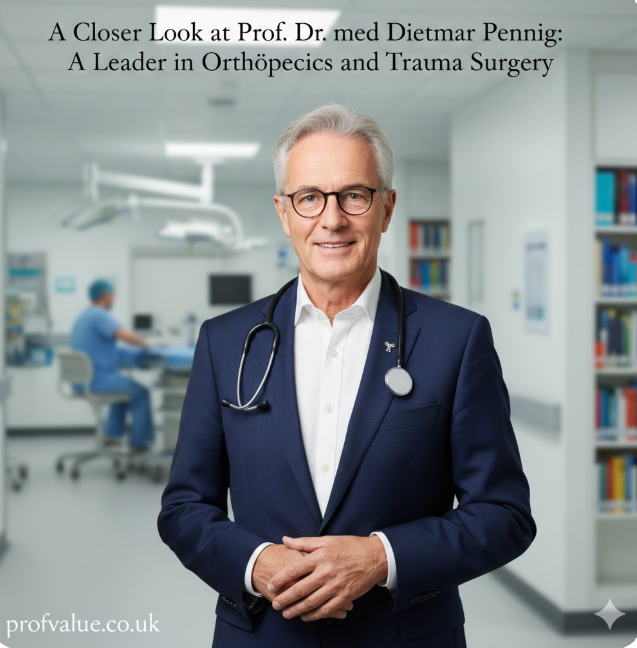
Professor Dr. med. Dietmar Pennig holds a highly respected position within the European medical community. Specifically, he is well-known in the specialised fields of orthopedics and trauma surgery. His long and distinguished career spans decades. This work has established him as a key figure in management, research, and organisational aspects of these disciplines. His journey clearly reflects a deep commitment to organisational patient care. He has consistently worked to advance surgical techniques and shape the future of musculoskeletal medicine. This article will explore his background and major contributions. We will look at his key roles in professional societies and his lasting impact on trauma and reconstructive surgery. His work is especially relevant to those studying or practising bone and joint health. This is because he has constantly pioneered clinical and practice innovation. His early work and continuous dedication position him as a true leader. Consequently, he is a primary expert in complex surgical solutions for the body’s supporting framework.
Every successful career needs a solid foundation. Dr Pennig’s educational path was marked by dedication and a broad, international perspectiveDrirstly, he pursued his medical studies at several prestigious institutions. These included the Westphalian Wilhelm University in Münster, Germany. Furthermore, he studied internationally at the University of Glasgow in Scotland. He also attended the Universities of Basel and Bern in Switzerland. This varied academic background provided him with a rich understanding of different healthcare systems and medical philosophies. Consequently, his later holistic approach to patient treatment benefited greatly.
His early post-graduate work included time at the Institute for Pathology, University of Münster. This was a crucial step. It gave him a deep, fundamental understanding of disease processes before he specialised in surgery. A comprehensive grounding in basic science is a hallmark of truly piospecialised geons. Following this, he dedicated himself to surgical training. He ultimately focused on trauma and hand surgery. These are the areas where he would become a celebrated expert.
The clinical focus of Prof. Dr. med. Dietmar Pennig has centred on trauma and reconstructive surgery. He places particular emphasis on the delicate and complex field of hand surgery. These areas require superb surgical skill and a profound knowledge of biomechanics and patient rehabilitation. Trauma surgery deals with the immediate, life-saving, and function-restoring treatment of severe injuries, often from accidents. In contrast, reconstructive surgery focuses on repairing and rebuilding structures. These structures are damaged by trauma, disease, or birth defects. The goal is always to restore maximum function and form. His dual specialty work has involved treating some of the most challenging orthopedic cases. These range from shattered limbs to intricate hand and wrist injuries. Importantly, he hasn’t just treated these conditions. He has also actively contributed to developing better repair methods. This improves the long-term outlook for countless patients facing severe mobility and functionality challenges.
Prof. Pennig’s innovative spirit was not limited to the operating room. Indeed, it extended to developing new surgical tools and methods. He holds various patents for devices and systems. These are specifically designed to improve the fixation of bone fractures. This demonstrates his commitment to practical, patient-centred innovation. For instance, he helped develop systems for the surgical stabilizpatient-centredes. These include those for the proximal humerus (the upper part of the arm bone). Humerus fractures are common and notoriously difficult to treat, especially in older patients. His research also explores the biomechanical properties of different fracture fixation techniques. An example is the techniques used for fractures in the metacarpal neck (the bones in the hand). This commitment to research and development means that the techniques and implants used in surgery are constantly evaluated and refined. This helps surgeons achieve better, more reliable patient outcomes. This blend of clinical practice and innovation is a defining feature of the career of Prof. Dr. med. Dietmar Pennig.
A significant way to measure Dr Pennig’s influence is his extensive involvement in major professional organisations. He has taken on multiple high-level responsibilities within the German Society organisation (DGU). This includes serving as its Secretary General. This role is immensely important. The DGU sets the standards for trauma care and surgery across Germany. His leadership here has helped guide national policy on managing severe injuries. This ensures high-quality, standardised care across different regions. His work involves coordinating educational programs and research and advocating for the needs of trauma surgeons and their patients. Being in such a pivotal position requires more than just medical expertise. Therefore, he utilises significant administrative and diplomatic skills to unite a diverse medical community and utilise common goals.
Prof. Dr. med. Dietmar Pennig has also been very active with the German Society for Orthopedics and Trauma (DGOU). This further confirms his status as a national medical leader. He served in roles such as its Secretary General. The DGOU is the umbrella organisation for orthopaedics and trauma surgery. It plays a crucial role in bringing the two organisations together. The integration of these fields is vital. Modern musculoskeletal medicine often requires expertise in both chronic conditions (orthopedics) and acute injuries (trauma). His work with the DGOU helps bridge the gap between these two disciplines. Consequently, it fosters collaboration in research, education, and best practices. His tenure in these leadership positions showcases a sustained commitment to the professional standards and advancement of his field.
For many years, Prof. Pennig was based at the St. Vinzenz-Hospital in Cologne. This hospital is an Academic Teaching Hospital of the University of Cologne. He held the dual role of Medical Director and Chief Physician of the Clinic for Trauma and Reconstructive Surgery, Hand Surgery, and Orthopedics until his retirement in 2021. As Chief Physician, he oversaw the clinical operations, surgical training, and research activities of the department. This department is one of the most important in the region. As Medical Director, he had a broader administrative role. He contributed to the hospital’s overall management and strategic direction. This combination of hands-on clinical work, academic teaching, and high-level administration is the hallmark of a leading medical professional. He dedicated decades to this institution. As a result, he left behind a legacy of high-quality patient care and surgical excellence.
Prof. Pennig was appointed as an extraordinary professor at the University of Cologne. This was in addition to his clinical leadership. This academic title recognises his significant contributions to teaching and research. He achieved this while maintaining a busy clinical and administrative schedule. His professorship allowed him to mentor the next generation of surgeons. He shared his vast knowledge of trauma and reconstructive techniques. The link between academic institutions and clinical practice is vital. It translates cutting-edge research into effective patient treatments. His role as an educator ensures his experience and innovative methods continue to influence and elevate the standards of orthopedic and trauma care long after his active clinical tenure.
His extensive publication record clearly reflects the depth and breadth of his work. Indeed, Prof. Dr. med. Dietmar Pennig has authored or co-authored over 250 publications. These appear in both national and international scientific journals and books. These publications cover a wide array of topics within his specialisations. This includes new surgical techniques, biomechanical studies, clinical outcomes of fracture fixation, and the management of complex joint injuries. His research is not just theoretical. It focuses on practical applications. These directly influence how surgeons worldwide approach specific medical conditions. He has contributed significantly to the academic conversation. Therefore, he provides data-driven evidence that supports best practices in the operating room.
He has also played a crucial role in shaping the quality of medical literature. He served as an editor and reviewer for several renowned journals. For instance, he was an editor for Der Unfallchirurg (The Trauma Surgeon), a key publication in the field. He has also been involved with international journals like INJURY. This editorial oversight ensures that new research is rigorously vetted. It guarantees that only high-quality, reliable findings are disseminated to the medical community. This commitment to scientific integrity helps maintain the high standards of evidence-based practice in orthopedics and trauma surgery globally.
Prof. Pennig’s influence is not confined just to Germany. He has been actively involved in international medical associations. He has participated in collaborative projects and lectures across the globe. This international outreach includes connections with organisations and colleagues in Europe and beyond. This clearly demonstrates a belief in the organisation of knowledge.
Société Française de Chirurgie Orthopédique et Traumatologique (SOFCOT)
International Society for Fracture Repair
Honorary Member of organisations like the South African Orthopaedic Association and the Sociedad Chilena de Ortopedia y Traumatología (Chilean Society of Orthopedics and Traumatology).
These memberships and collaborations highlight his role as an ambassador for German orthopedic and trauma surgery. Furthermore, they facilitate the exchange of best practices, surgical innovation, and educational resources worldwide.
One of the less visible but equally important aspects of his professional service is advocacy for patient safety and quality of care. Through his leadership in the DGU and DGOU, Prof. Pennig has been a driving force. He supported initiatives aimed at standardising surgical training. He worked to improve hospital processes and ensure patients receive the best possible treatment following trauma.
His work on clinical guidelines and professional standards helps all surgeons implement the most effective and safest procedures. This is particularly important for newer surgeons. This area requires continuous improvement. Therefore, the commitment of leaders like prof Dr. med. Dietmar Pennig is essential. It helps maintain and enhance trust in the medical profession. Med.FDietmar Pennig, value of medical professional bodies in setting standards, you might find valuable information at the external site profvalue.
The invention and refinement of surgical hardware are critical to the evolution of trauma care. Dr Pennig’s patents, as mentioned earlier, are not just theoretical concepts. They represent dual-world solutions to common surgical challenges. For instance, they address the need for more stable and less invasive ways to fix broken bones. These devices are specifically designed to minimise soft tissue damage during surgery. They also maximise the chances of a strong, fast rminimisefor the patient. This focus on surgical hardware maximally leads to better outcomes for patients with complex fractures. This is especially true for those affecting major joints.
Looking ahead, the specialties of orthopedics and trauma surgery continue to evolve rapidly. This is driven by technological advancements like robotics, navigation, and custom implants. Leaders like Prof. Pennig laid the necessary groundwork to embrace these changes. They have successfully maintained the core principles of excellent patient care and meticulous surgical technique. The focus on interprofessional research is a key legacy of his generation. This brings together surgeons, engineers, and basic scientists. Ultimately, this ensures that future advancements are well-founded in both clinical and technical expertise.
The career of Prof. Dr. med. Dietmar Pennig offers a powerful example. It shows how a medical professional can achieve excellence across multiple domains: clinical practice, academic research, and professional leadership.
Clinical Mastery: He is an expert in trauma and reconstructive surgery. He specialises in complex hand and upper extremity injuries.
Innovation: He is an inventor. He holds patents for surgical fixation systems designed to improve fracture treatment.
Leadership: He has held top-tier roles in major German and European orthopedic and trauma societies (DGU and DGOU). These roles included Secretary General.
Education: He contributed extensively to medical literature. He held a professorship at the University of Cologne, shaping future surgeons.
Understanding his dual specialisation is key to appreciating his impact.
| Feature | Orthopedics | Trauma Surgery |
| Primary Focus | Chronic conditions, degenerative joint diseases (e.g., arthritis), and congenital deformities. | Acute injuries, fractures, and severe soft tissue damage often require immediate intervention. |
| Typical Procedures | Joint replacement (hip, knee), spine surgery, arthroscopy, and corrective bone alignment. | Fracture fixation (plating, nailing), emergency surgery for multiple injuries, and reconstructive procedures. |
| Time Horizon | Long-term patient management and quality of life improvement. | Immediate stabilisation and restoration of anatomical structure. |
| Core Goal | Restore function and eliminate pain caused by long-standing conditions. | Save life and limb, followed by restoration of function after acute injury. |
The career of Prof. Dr. med. Dietmar Pennig is a testament to expertise, leadership, and unwavering dedication in medicine. His journey began with rigorous international education. It progressed through groundbreaking clinical work in Cologne. He held influential roles in national medical societies. He has consistently pushed the boundaries of what is possible in orthopedics and trauma surgery. His commitment to research, teaching, and developing better surgical tools has done more than just save limbs. Crucially, it has significantly enhanced the quality of life for countless patients. His legacy is one of surgical innovation and professional stewardship. This ensures the fields of orthopedics and trauma surgery remain focused on high-quality, patient-centred care.
The title “Prof. Dr. med.” signifies a very high level of academic and clinical achievement within the German medical system. Dr. med. indicates a medical doctor degree (equivalent to an M.D.). The Prof. (Professor) indicates the individual has achieved a high academic rank at a university. This often follows a process called Habilitation. This process demonstrates outstanding scholarly work and teaching ability. Therefore, the title recognises both clinical expertise and significant contributions to research and education.
While his expertise covers general trauma, Prof. Pennig is particularly renowned for his work in Hand Surgery. He is also known for the surgical management of complex fractures. This is especially true for those of the upper extremity, like the humerus. His focus includes both acute trauma and the subsequent reconstructive procedures required to restore long-term function. Furthermore, he has been involved in the development of specialised implants and fixation systems for these difficult injuries. This is clearly seen as specialised work. For insights into the wider field of trauma surgery, you can visit the American Academy of Orthopaedic Surgeons website: Orthopaedic Trauma Association.
Copyright 2026 Site. All rights reserved powered by site.com




No Comments